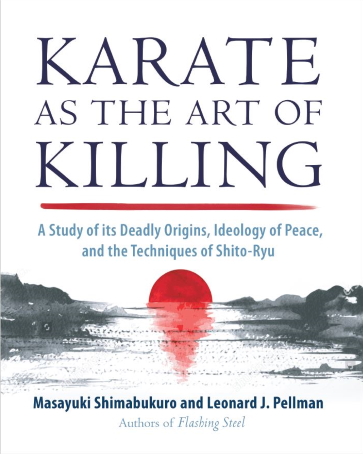
Karate As the Art of Killing
In 2006, Shimabukuro Masayuki Hanshi and Leonard J. Pellman Shihan collaborated to produce their landmark book on traditional karate-dō, Katsujinken: Living Karate & The Way To Self-Mastery. Their goal in writing Living Karate was to provide a philosophical and technical foundation for karate-ka of all styles and backgrounds.
Unfortunately, the book did not garner the degree of cross-over appeal the authors had anticipated. While Living Karate was well-received within the Shitō-Ryū community, it did not gain popularity in other styles of karate and taekwondo, which thwarted the purpose and intent of the book.
After three years of attempting to promote Living Karate to a more general audience, Shimabukuro and Pellman came to the conclusion that it would not become the universal thesis on karate-dō they had intended. So in late 2009, they began work on a second book on karate.
This time they approached the subject quite differently. The new book would be a master treatise on Shitō-Ryū karate-do that would examine the art from a perspective not previously explored in print: its true purpose and nature. Shimabukuro Hanshi had begun his karate training in 1965 as a direct student of Hayashi Teruō, the former president of the Seishin-Kai and founder of Hayashi-Ha Shitō-Ryū. In 1996 he became a direct student of Mabuni Kenzō, son of the founder of Shitō-Ryū and nidai-me Sōke of the style. From his many discussions with Mabuni Sōke, Shimabukuro significantly altered his understanding of karate-dō and his approach to teaching the art. The new book was to feature this enhanced understanding of the true nature of karate-dō, and serve as Shimabukuro Hanshi's isho (posthumous writings) on the subject ... Read more
Shimabukuro Hanshi's Isho
How The Art of Killing BeganWhen Shimabukuro Hanshi first began discussing the content of The Art of Killing with his co-author, Len Pellman, he remarked, "After this I want to focus more on Nippon budō, so this will be our final book about karate-dō. It will be my isho."
Pellman Shihan didn't understand the term, isho (遺書), when Hanshi first mentioned it, so he looked it up afterward. He was shocked to find that it means "posthumous writings," and asked Hanshi about it at their next meeting.
"Isho doesn't only mean book published after death. It also means ... how you say? ... final legacy. It doesn't mean I'm dying, Len-san. This isho will be our legacy for future generations of karate-ka. Tragically, that wasn't to be the case ... Read more
The concept for The Art of Killing came from conversations Shibukuro Hanshi had with Mabuni Kenzō Sōke in the late 1990s. In those conversations, Mabuni Sōoke spoke to Hanshi at length about the origins and history of karate-dō, and the reasons neither he nor his father believed in practicing karate as a sport.
"Karate is not a sport," Mabuni Soke told him in the first of those conversations, "And it was not developed for fist-fights or street fights. Karate was created for life or death combat, mostly against armed warriors."
Several conversations followed in which Mabuni Sōke explained in detail the origins and evolution of karate-dō as a combat system, and why both he and his father considered it a "samurai" art, despite its Okinawan origins. "The idea that karate was created by or for Okinawan peasants is a myth," he explained, "And you cannot understand or correctly perform karate, if you believe that myth." These revelations prompted Shimabukuro to significantly revise his approach to karate-dō and its instruction during the last ten years of his life. The Art of Killing reveals the details of ... Read more